
Bloom's Taxonomy Question Generator
Higher-order thinking questions are key to developing deeper understanding of complex concepts, but writing these might be trickier than you think. With Top Hat's easy-to-use tool, you can rewrite quiz questions to move students from rote memorization to the upper Bloom's Taxonomy levels.
Single Question Analysis
Enter one question to detect its cognitive level, then rewrite it to a new one.
What is Bloom's Taxonomy?
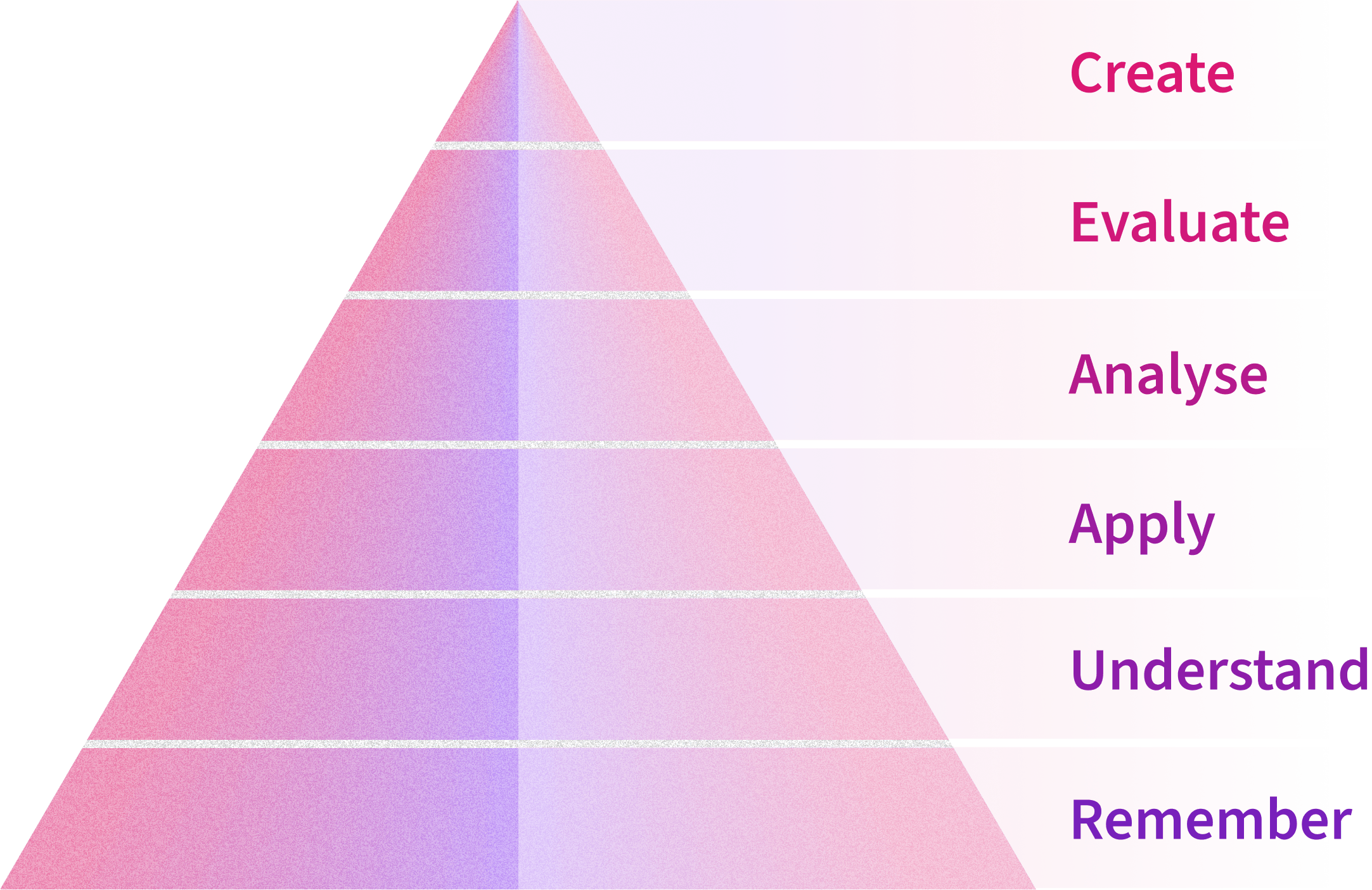
Bloom's Taxonomy is a framework that categorizes different levels of learning, starting with foundational skills like remembering and understanding, and moving up to higher-order thinking skills such as analyzing, evaluating, and creating.
Below are sample prompts that have been optimized to meet the upper levels of Bloom's Taxonomy. Take a look and then try it out for yourself!
Who was the first President of the United States?

Was George Washington's decision to step down after two terms more important for American democracy than any single policy he enacted as president? Defend your answer.
What is the definition of classical conditioning?
Build a brief intervention to reduce exam-related anxiety using extinction and counterconditioning. Outline steps, rationale and how you'd measure effectiveness.
What organelle is responsible for producing ATP in eukaryotic cells?
Mitochondria are often called the 'powerhouse of the cell.' Do you think this metaphor oversimplifies their role? Support your argument with evidence.
Frequently Asked
QuestionsHow can Bloom's Taxonomy improve assessments in higher ed?

Bloom's Taxonomy improves higher ed assessments by moving beyond rote memorization to measure critical thinking, application, and creativity. It helps align assessments with learning outcomes while scaffolding from simple recall to complex problem-solving. This makes evaluations more meaningful, engaging, and reflective of real-world skills.
How do I write better quiz questions that include Bloom's Taxonomy verbs?
You can write stronger quiz questions with Bloom's Taxonomy by first deciding which level of thinking you want to assess—recall, understanding, application, analysis, evaluation or creation. Start with clear learning objectives, then match your questions to them (e.g., a multiple-choice fact check for "remember," a scenario-based problem for "apply," or an open-ended comparison for "analyze"). To improve balance, include a mix of lower- and higher-order questions so students demonstrate both foundational knowledge and deeper critical thinking. Download our FREE Bloom's Taxonomy Question Stems resource for more than 100 ideas to use in your own classroom.
How do Top Hat's polls and quizzes support Bloom's Taxonomy?
Top Hat polls and quizzes support Bloom's Taxonomy by offering diverse question types (including click-on-target and matching) that target every cognitive level, from recall to creation. Instant feedback and analytics let students practice higher-order thinking in low-stakes settings while giving instructors real-time insights into learning progress. This helps educators scaffold effectively—reteaching fundamentals when needed and pushing students toward deeper analysis, evaluation and creation when ready.